Introduction
If you’re planning to power an RV, install a dedicated range, or add an EV charging solution, the NEMA 14-50 often comes up as the go-to outlet. This versatile 240V, 50-amp receptacle handles heavy-duty loads and supports multiple use cases. Below you’ll find what a NEMA 14-50 is, where it’s used, high-level wiring considerations, safety tips, and cost and code basics — all written in plain language so you can make an informed decision.
What is a NEMA 14-50 and what devices use it?
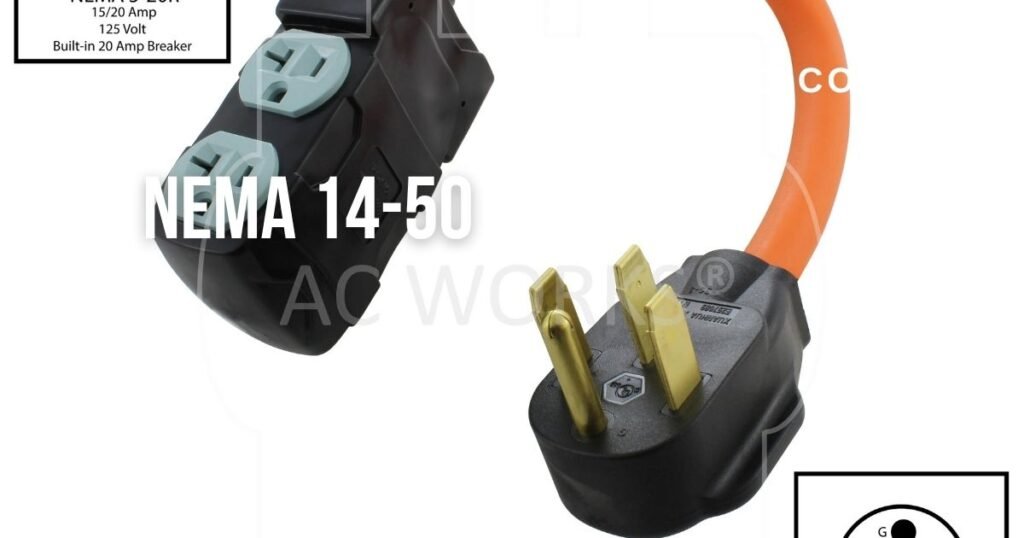
A NEMA 14-50 is a four-prong, 240-volt receptacle rated for 50 amps. The naming comes from the National Electrical Manufacturers Association (NEMA) standard that defines pin configuration and safety requirements. It’s commonly used for:
-
Electric ranges or ovens (in some installations).
-
RV shore power connections — many RVs use a 14-50P plug to draw up to 50 amps.
-
Level 2 EV charging (with appropriate EVSE) — popular with owners of vehicles like Tesla and other EVs.
-
Heavy appliances or equipment requiring a dedicated 240V circuit.
Because it provides two hot conductors plus a neutral and ground, the NEMA 14-50 can power both 240V-only loads and 120/240V appliances that need neutral.
Can I use a NEMA 14-50 outlet to charge an electric vehicle?
Yes — a NEMA 14-50 is a common option for home EV charging. Many EV owners use a NEMA 14-50 outlet paired with a portable EVSE (electric vehicle charger) that plugs into the 14-50R. Advantages include:
-
Faster charging than a standard 120V outlet (Level 2 charging).
-
Flexibility: plug-in portable chargers or dedicated hardwired chargers can be used.
-
Compatibility with many EVs, including Tesla (with an adapter) and other brands.
Note: A NEMA 14-50 does not inherently provide the smart functions of a hardwired EV charger (like app control or load balancing). If you want advanced features, consider a hardwired Level 2 EVSE or a professionally installed EV charger.
Wire gauge, breaker size and basic wiring principles
Proper wiring is critical for safety and code compliance. The typical configuration for a NEMA 14-50 includes:
-
A 50-amp double-pole breaker in the service panel. Brands like Siemens and Square D manufacture compatible breakers.
-
Conductors sized to handle continuous load: commonly 6 AWG copper (or equivalent) for the two hot legs and neutral where required. Grounding conductor size follows code.
-
A four-conductor cable run terminating in a 14-50R receptacle: hot (X), hot (Y), neutral (W), and equipment ground (G).
These are general guidelines. The National Electrical Code (NEC) governs conductor sizing, circuit protection, and installation specifics, which can change with code cycles and local amendments.
Do I need a permit or inspection to install a NEMA 14-50 outlet?
Most municipalities require a permit and inspection for any new 240V circuit or permanent outlet installation. Reasons:
-
Ensures the work complies with NEC and local code amendments.
-
Confirms correct breaker sizing and proper grounding.
-
Protects homeowners’ insurance and property resale value.
Hiring a licensed electrician is highly recommended — they can obtain permits, perform load calculations (to ensure your panel has capacity), and arrange an inspection. Retailers like Home Depot sometimes offer installation services, but make sure the installer is licensed locally.
Step-back wiring overview and safety
For safety, think of wiring a NEMA 14-50 as three major tasks (high-level):
-
Panel evaluation & load calculation — make sure the service and panel can accept another 50-amp branch circuit without overloading.
-
Circuit installation — run appropriately sized cable from the panel to the outlet location, install a matched 50-amp double-pole breaker, and connect hot/neutral/ground to the receptacle.
-
Inspection & testing — verify continuity, polarity, and ground integrity; obtain final approval from the local inspector.
Important safety note: Don’t attempt to install a 240V 50-amp circuit unless you are a qualified electrician. Incorrect wiring can cause fire hazards, shock risk, and code violations.
Dryer outlet vs NEMA 14-50 what’s the difference?
Many homeowners confuse dryer outlets with 14-50 receptacles. Key differences:
-
Residential dryers commonly use a NEMA 14-30 (30 amp) or older 3-prong 240V outlet — smaller amperage and different pin configuration.
-
The 14-50 is larger, rated at 50 amps, and has a distinct pin layout so plugs cannot be interchanged incorrectly.
-
Never plug a device into a mismatched outlet; the amperage and pin arrangement prevent safe operation.
Cost considerations how much does it cost to install a NEMA 14-50 outlet?
The price range depends on complexity:
-
Simple install (panel with spare capacity, short run): $300–$700* — covers materials, receptacle, and labor.
-
Moderate install (panel upgrade, longer cable run, permit): $700–$1,500* — may include a subpanel or minor upgrades.
-
Major work (service upgrade, trenching for outdoor outlet, panel replacement): $1,500–$4,000+*.
*Estimates vary by region and electrician rates. Always get multiple quotes and confirm permit handling.
Maintenance, troubleshooting and lifespan
A NEMA 14-50 is robust but not maintenance-free:
-
Inspect the receptacle periodically for loose connections, discoloration, or burning smell.
-
If an outlet becomes warm under normal load, stop using it and have an electrician evaluate it.
-
Consider inline surge protection if powering sensitive EV charging equipment.
-
Properly installed, a receptacle can last decades; the limiting factors are usage patterns and environmental exposure.
Troubleshooting basics: confirm the breaker isn’t tripped, test outlet voltage with a multimeter (only if qualified), and call a licensed electrician for wiring faults.
Real-world example:
Picture two homeowners: Maria installs a NEMA 14-50 in her garage for EV charging; James installs a 14-50 in his outdoor RV pad. Maria wanted a clean, indoor outlet near her parking spot and chose an EVSE that plugs into the 14-50R for Level 2 charging. James opted for a weatherproof 14-50 with a lockable cover for seasonal RV use and an adapter to match his coach’s cord. Both required permits, and both benefited from a licensed electrician’s load calculation to prevent panel overload.
Conclusion
The NEMA 14-50 is a flexible, high-capacity outlet that fits EV owners, RVers, and heavy-appliance needs. While its installation is straightforward for professionals, safety, code compliance, and correct load calculations make a licensed electrician indispensable. Ready to add a 14-50 to your home? Get three local electrician quotes, confirm permitting, and choose UL-listed components from trusted brands like Leviton or Siemens for a safe, durable setup.
Also Read : 2024 Nissan Altima: The Smart Sedan for Modern Drivers
FAQ
1. What is a NEMA 14-50 and what devices use it?
A NEMA 14-50 is a 240V, 50-amp, four-prong receptacle used for EV charging, RV shore power, and some heavy appliances.
2. Can I use a NEMA 14-50 outlet to charge an electric vehicle?
Yes. Many EV owners use portable or plug-in Level 2 EVSE with a NEMA 14-50. For smart charging features consider a hardwired EV charger.
3. What wire gauge and breaker size are required for a NEMA 14-50 receptacle?
Typically a 50-amp double-pole breaker with 6 AWG copper conductors is used, but always follow NEC and local code requirements.
4. Do I need a permit or inspection to install a NEMA 14-50 outlet?
Most jurisdictions require permits and inspections for 240V branch circuits. Hire a licensed electrician to handle permitting and inspection.
5. How much does it cost to install a NEMA 14-50 outlet at home?
Costs range widely: roughly $300–$1,500 for standard installs and more if panel upgrades or trenching are needed.