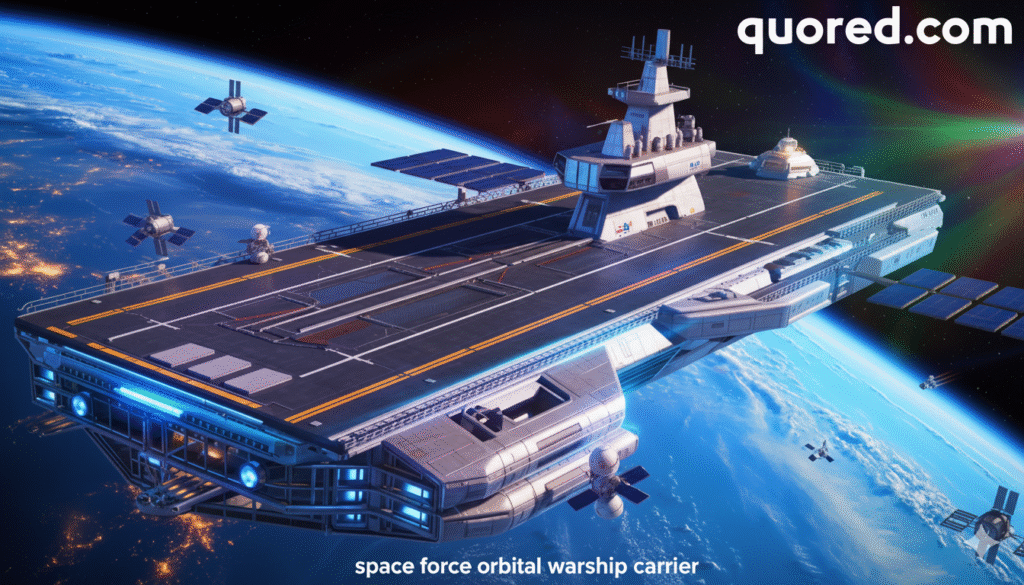
Space Force Orbital Warship Carrier
Introduction
Imagine a seaborne aircraft carrier moved into the sky — now place it in space. The concept of a space force orbital warship carrier blends mothership architecture, fighter bays, and on-orbit refueling to project power in LEO and beyond. In this piece we’ll unpack how such a carrier might operate, the tech behind it, legal limits, and realistic timelines for deployment.
What is an orbital carrier and why the U.S. Space Force might want one
An orbital carrier is essentially a mothership spacecraft: a modular, crewed or autonomous platform hosting smaller craft (autonomous space drones, unmanned combat vehicles, and ISR sensors). For the U.S. Space Force and allied partners, an orbital carrier provides persistent space situational awareness (SSA), rapid response via launch-on-demand drones, and on-orbit logistics like refueling and repair. Think of it as a floating base with docking ports, fighter bays, and a habitat module — a combination of space logistics and tactical command and control (C2).
Core systems: propulsion, power, and sustainment
Propulsion and stationkeeping
-
Electric propulsion / ion engines for efficient LEO operations and relocations.
-
Nuclear thermal propulsion might be considered for cislunar repositioning or deep-space sustainment.
-
Propulsion staging and space tugs handle transfers between LEO and higher orbits.
Power and weapons platforms
-
Large solar arrays or nuclear reactors provide power for sensors, lasers, and electromagnetic weapons (e.g., electromagnetic railgun).
-
Onboard power supports space-based lasers and directed-energy defenses against incoming threats.
Sustainment systems
-
On-orbit refueling, spare parts, and habitat resupply enable long deployments.
-
Modular architecture allows swapping mission modules: sensor suites one month, strike modules the next.
Operational concepts: how an orbital carrier would fight and defend
An orbital carrier is not a “battleship” firing shells at Earth; it’s a mobile node in a layered space defense and offense architecture.
-
Persistent ISR & SSA — constant monitoring for threats to satellites, with sensors and ISR arrays.
-
Rapid response drones — autonomous space drones launched from fighter bays to inspect, repair, or disable targets.
-
Active defense — directed-energy weapons and countermeasures to protect high-value assets.
-
Offensive options — non-kinetic measures such as disabling jammers, cyber tools, and, at extreme, kinetic interceptors; kinetic bombardment remains politically and legally sensitive.
Real-life analogy: Imagine naval carrier strike groups: an aircraft carrier provides the runway, the destroyers provide escort. In space, the orbital carrier supplies the launch platform, while accompanying satellites and tugs handle escort and logistics.
Design features and modular elements
-
Fighter bays and hangars sized for reusable spaceplanes or drone swarms.
-
Docking ports compatible with commercial partners like SpaceX and Blue Origin cargo tugs.
-
Habitat module with life-support for mixed human-robot crews.
-
Rapid reconfiguration bays to swap payloads (sensor, comms, weapons).
-
Space tugs for moving modules and on-orbit assembly.
Technology enablers: who builds what? (Entities in play)
-
SpaceX and Blue Origin can provide reusable launch and cargo delivery to the carrier.
-
Defense primes like Lockheed Martin, Northrop Grumman, and Boeing would design the carrier’s structure, docking and C2 architecture.
-
DARPA often prototypes disruptive modules and autonomous drones.
-
NASA expertise in life support and orbital assembly contributes to habitat modules.
-
The U.S. Space Force defines mission requirements and doctrine; leadership figures like General John W. Raymond shaped early Space Force strategy. And public visionaries like Elon Musk influence commercial capabilities that make carriers economically plausible.
Operational environments: LEO, GEO, and cislunar
-
LEO operations: rapid tactical response, satellite defense, and rendezvous operations.
-
GEO stationkeeping: strategic communications hubs and persistent monitoring of wide-area assets.
-
Cislunar operations: projecting presence to lunar orbits, enabling deeper logistics and staging.
Each environment requires tailored propulsion, thermal control, and stationkeeping strategies.
Tactics, rules of engagement, and legal constraints
Are orbital carriers legal? International space law, especially the Outer Space Treaty, prohibits weapons of mass destruction in orbit and claims of sovereignty. Conventional weapon placement and kinetic strikes in space raise serious legal and diplomatic questions. Nations will likely rely on non-kinetic tools (electronic warfare, cyber, and defensive lasers) and carefully defined rules of engagement tied to attribution and proportionality.
Space traffic management and collision avoidance also become critical — carriers must coordinate with civilian operators to prevent catastrophic debris-generating events.
Challenges: cost, debris, and escalation risk
-
Cost: building, launching, and sustaining a carrier is expensive — requiring public-private partnerships.
-
Debris risk: kinetic actions produce debris; even small collisions can cascade (Kessler syndrome).
-
Escalation: an orbital carrier’s presence could be seen as threatening, prompting arms-race dynamics.
Mitigations include modular, reversible deployments; transparency with international partners; and non-kinetic capability emphasis.
A plausible timeline: prototypes to operational concept
-
Short term (5–10 years): Demonstrations of modular habitats, space tugs, and fighter bay prototypes using commercial launch systems.
-
Medium term (10–20 years): Operational prototypes for LEO persistent presence, testbeds for on-orbit refueling and autonomous drone swarms.
-
Long term (20+ years): Mature, multi-orbit carriers with cislunar reach and integrated international logistics.
This timeline depends on budgets, tech breakthroughs (e.g., scalable nuclear thermal propulsion), and policy choices.
Benefits: what an orbital carrier enables
-
Rapid satellite repair and resiliency through on-orbit refueling and servicing.
-
Faster response to hostile acts against space infrastructure.
-
Flexible presence for humanitarian monitoring, disaster response, and science missions.
Risks and ethical considerations
Beyond debris and escalation, there are ethical considerations: weaponizing space could harm civilian satellites, emergency communications, and scientific missions. The debate should involve industry (SpaceX, Blue Origin), science agencies (NASA), defense (Lockheed Martin, Northrop Grumman), and international partners.
Conclusion
A space force orbital warship carrier blends naval thinking with aerospace engineering: modular motherships, fighter bays, on-orbit refueling, and autonomous drones—offering resilient space operations but raising legal and escalation concerns. Want a deeper dive into propulsion options, modular designs, or international law implications? Tell me which section you want expanded and I’ll drill down with diagrams and a tech roadmap.
Also Read: Yuppow: Automate Smarter, Work Faster
FAQ (answers to PAA questions)
Q1 — What is a space force orbital warship carrier?
A: It’s a large, modular spacecraft—manned or unmanned—that hosts smaller vehicles (drones, spaceplanes) for mission flexibility. It acts like a sea carrier but operates in orbits (LEO, GEO, cislunar).
Q2 — How would an orbital carrier operate and support missions?
A: Through on-orbit refueling, docking ports, fighter bays, space tugs, and a command-and-control hub providing ISR and rapid dispatch of autonomous drones.
Q3 — What weapons and defenses could an orbital warship carry?
A: Non-kinetic options (directed-energy lasers, electronic warfare), defensive countermeasures, and optionally kinetic interceptors. Lethal, debris-producing strikes are legally and strategically sensitive.
Q4 — Are orbital carriers legal under current space law and treaties?
A: The Outer Space Treaty bans nuclear weapons and claims of sovereignty; weapon placement is a gray area. Most nations favor non-kinetic defensive capabilities and transparency to avoid treaty violations.
Q5 — When might we see a real space force orbital warship carrier in service?
A: Practical prototypes and demonstrators could appear within 5–20 years; fully operational, multi-orbit carriers may take longer and depend on policy and funding.